
The construction industry is at a breaking point.
 Rising labor shortages, unpredictable material costs, and long build timelines are forcing homeowners and developers to rethink how buildings are made. Traditional construction hasn’t evolved fast enough to match modern demand – but modular construction has.
In 2026, modular building is no longer an alternative approach. It’s becoming a smarter standard.
This guide compares modular vs traditional construction across cost, speed, quality, and long-term return on investment.
What Modular Construction Really Means
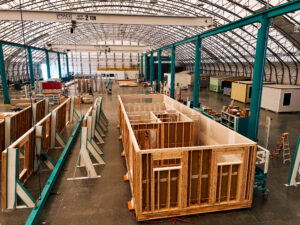
Modular construction is a factory-based process where the majority of a structure is built indoors before being delivered to the site for final installation. Instead of assembling everything outdoors under changing weather and labor conditions, the home is manufactured in a controlled environment with engineering precision.
At S2A Modular, homes, ADUs, multi-family projects, and commercial buildings are produced inside a high-performance MegaFactory. This environment allows tighter quality control, faster timelines, and greater efficiency than conventional job sites.
The result isn’t just faster construction – it’s a different way of thinking about how buildings should be made.
Build Speed: Why Timeline Matters More Than Ever
Traditional construction often stretches across 12 to 24 months. Permitting delays, weather interruptions, subcontractor scheduling conflicts, and material shortages can push projects far beyond their original timeline.
Modular construction changes the equation by allowing site preparation and factory production to happen at the same time. Because the majority of the build happens indoors, weather delays are eliminated and logistics are streamlined.
Most modular projects reduce overall timelines by 30-60%. That acceleration has real financial impact. Earlier completion means faster occupancy, faster rental income, and faster return on investment – a major advantage in high-demand markets.
Cost Efficiency Without Compromising Quality
 There’s a common misconception that modular construction is cheaper because quality is sacrificed. In reality, modular saves money by eliminating inefficiency, not standards.
Factory production reduces material waste, allows bulk purchasing, and minimizes unpredictable labor costs. Traditional construction projects often experience mid-build price escalations. Modular projects operate with tighter cost control and greater pricing transparency from the beginning.
For both homeowners and developers, predictability is one of the most valuable financial benefits of modular building.
Precision Manufacturing vs On-Site Variability
Traditional construction depends heavily on outdoor working conditions and individual crews. Quality can vary from site to site and even day to day.
Modular construction replaces variability with repeatable precision. Buildings are produced using engineering-grade measurements, factory inspections, and standardized quality systems. Controlled environments protect materials and ensure consistency throughout the process.
Factory-built does not mean lower quality. It means higher consistency and fewer unknowns.
Long-Term ROI and Property Value
Modern modular homes are built to meet or exceed local building codes and are appraised similarly to traditional homes. As modular adoption increases, resale perceptions continue to strengthen.
Owners benefit from faster move-in timelines, lower financing exposure, and reduced maintenance surprises. In strong housing markets, the ability to complete a project faster often has a direct impact on profitability and asset value.
The return isn’t just in construction savings – it’s in the lifecycle performance of the property.
Why Modular Construction Is Scaling in 2026
 Several global forces are accelerating modular adoption. Cities facing housing shortages need faster, scalable solutions. Skilled labor gaps are widening. Environmental standards are tightening. Developers are under pressure to deliver projects faster without sacrificing quality.
Factory-built construction addresses all of these pressures simultaneously. It combines industrial efficiency with architectural flexibility, allowing builders to scale without losing craftsmanship.
What once felt experimental is now becoming infrastructure.
Who Modular Construction Serves Best
Modular construction supports a wide range of projects. Primary residences, ADU investments, multi-family developments, commercial spaces, and hospitality builds all benefit from accelerated timelines and controlled manufacturing.
Any project where speed, cost predictability, and quality consistency matter becomes a strong candidate for modular delivery.
The Smarter Build Strategy
Traditional construction isn’t disappearing – but it’s no longer the only benchmark. Modular construction represents an evolution in how buildings are designed, manufactured, and delivered.
Faster timelines, tighter cost control, and higher consistency are reshaping expectations across the industry. As demand for smarter housing grows, modular construction is positioned to lead the next era of development.
Ready to Explore What’s Possible?
If you’re considering a modular home, ADU, or development project, the first step is understanding what’s achievable for your property and timeline.
Explore S2A Modular floorplans, request pricing, or schedule a consultation to see how modular construction can work for you.
The FUTURE of building is already here.
Frequently Asked Questions About Modular Construction
Are modular homes cheaper than traditional homes?
Modular homes are often more cost-efficient because factory production reduces labor waste, material loss, and construction delays. While upfront pricing depends on size, design, and site preparation, modular projects typically maintain tighter budget control than traditional builds. The biggest savings often come from faster timelines and reduced financing exposure rather than lower quality materials.
How long does it take to build a modular home?
Most modular homes can be completed significantly faster than traditional construction. Because site preparation and factory manufacturing happen simultaneously, total build time is often reduced by 30-60%. While timelines vary by project scope and permitting, modular delivery eliminates many of the weather and scheduling delays common in on-site construction.
Are modular homes built to the same standards as traditional construction?
Yes. Modern modular homes are built to meet or exceed local and state building codes. Factory environments allow for consistent inspections, engineering precision, and controlled material handling. In many cases, modular construction produces tighter tolerances and stronger quality control than traditional outdoor job sites.
Do modular homes hold their value?
Modular homes appraise similarly to traditional site-built homes when constructed to residential building standards. As modular adoption increases, resale value perception continues to improve. Market demand, location, and design quality influence appreciation in the same way they do for conventional homes.
Can modular homes be customized?
Modular construction allows for extensive customization in layout, finishes, and architectural design. Buyers are not limited to standard templates. Many modular manufacturers, including S2A Modular, design homes to match specific property requirements, lifestyle needs, and investment goals.
Is modular construction only for small homes or ADUs?
No. Modular construction supports projects ranging from small ADUs to luxury residences, multi-family developments, commercial spaces, and hospitality buildings. The scalability of factory production makes it suitable for both individual homeowners and large-scale developers.
Why is modular construction becoming more popular?
Housing shortages, labor challenges, and rising construction costs are pushing the industry toward more efficient solutions. Modular construction offers faster delivery, predictable pricing, and consistent quality. These advantages make it increasingly attractive to homeowners, investors, and cities looking for scalable housing solutions.